Classical Greek
Token, sign, ticket, treaty
σύμβολον already covers inference, hospitality tallies, pledges, jury tokens, permits, and interstate covenants. The physical object and the agreed sign live in the same word.
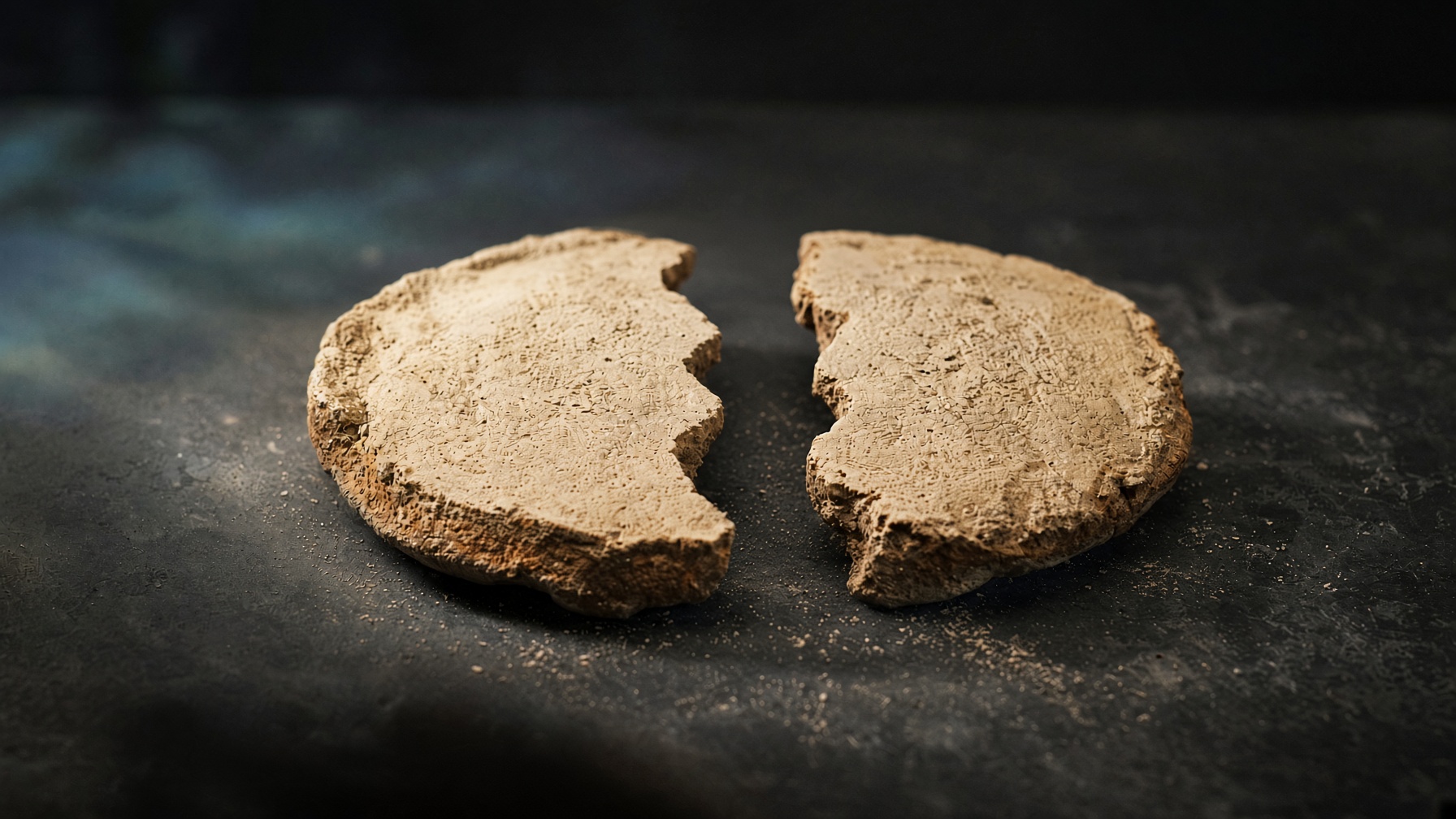
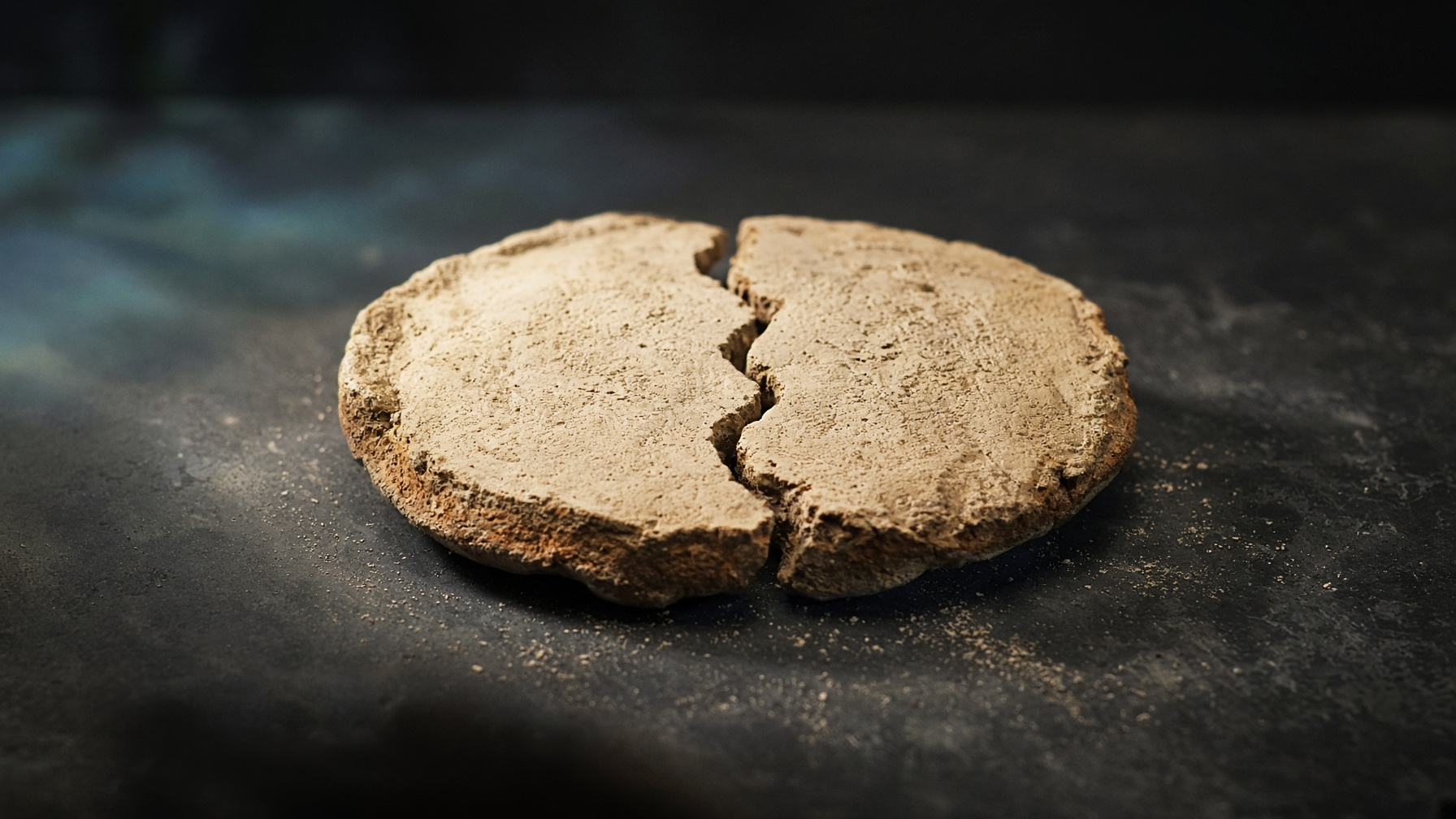
How does a fragment become a sign?
The pieces are apart.
I
What did symbolon originally mean?
Before a symbol was a mark on a page, the Greek word σύμβολον could name something held in the hand. The noun belongs with the verb συμβάλλω: σύν, together, and βάλλω, to throw or to put. To throw together. To meet. To compare. To contribute. To infer. The word already arrives with a crowd.
A lexicon is not a romance. Middle Liddell, condensing Liddell and Scott, records several offices for σύμβολον. A sign or token by which one infers a thing. A pledge on which money was advanced. In the plural, tallies: halves of a bone or coin which two people broke between them, each keeping a piece, the Latin tesserae hospitales. At Athens, a ticket or counter, including the one a juror presented for pay. A permit for a resident alien. A ticket brought to a shared meal. In the plural again, covenants between cities for the protection of commerce. Later, in ecclesiastical Greek, a creed: the distinctive mark by which Christians recognized a shared confession.
Not every ancient symbolon was a broken token of affection. Hospitality tokens are one documented use, not the whole word. A beacon can be a symbolon because someone infers a message from it. A treaty can be a symbolon because two cities have put their terms together. A password can be a symbolon because the right sign lets you pass. The common act is correspondence used for recognition, agreement, or inference. The later metaphor of lovers as matching halves is a literary use of that act. It does not rewrite the lexicon.
Henry George Liddell and Robert Scott, A Greek-English Lexicon, the sense range as condensed in Middle Liddell, via the Scaife Viewer. Headword σύμβολον. The etymology συμβάλλω from σύν and βάλλω is the standard analysis, also given in the English Wiktionary entry citing Liddell and Scott.
The lexicon cites tragedy for the inferential sign, including Aeschylus for λαμπάδος τὸ σύμβολον, the token of the beacon-fire. It cites Herodotus and Euripides for the tallies, Lysias for the pledge, Demosthenes for the juror's ticket and for interstate σύμβολα, Aristophanes for the alien's permit and the picnic ticket. This page follows that sense list. It does not pretend each passage was re-edited here.
II
Why does Plato compare a person to a symbolon?
ἕκαστος οὖν ἡμῶν ἐστιν ἀνθρώπου σύμβολον, ἅτε τετμημένος ὥσπερ αἱ ψῆτται, ἐξ ἑνὸς δύο· ζητεῖ δὴ ἀεὶ τὸ αὑτοῦ ἕκαστος σύμβολον.
Each of us, then, is but a tally of a man, since every one shows like a flat-fish the traces of having been sliced in two; and each is ever searching for the tally that will fit him.
Aristophanes is not lecturing. He is telling a comic myth at a drinking party, after a bout of hiccups that made him trade places in the order of speeches. Once, he says, human beings were round double creatures. Zeus cut them apart. Love is the old wound trying to close. Each of us is a symbolon of a human: a fragment searching for the fragment that fits.
The image is exact because a symbolon was already a thing whose broken edge could recognize its other. Aristophanes borrows a civic and domestic object and sets it inside a body. Eros, in this speech, is not a theory of signs. It is longing for a prior whole. Hephaestus, later in the same speech, offers to weld two lovers into one. That is still myth, and still comedy, and still not the last word in the room.
The Symposium is a contest of accounts. Phaedrus, Pausanias, Eryximachus, Aristophanes, Agathon, then Socrates reporting what he says he learned from Diotima, then Alcibiades at the door. Diotima's ladder, from beautiful bodies toward the beautiful itself, is the dialogue's philosophical center. It does not erase Aristophanes. It refuses to let one speech be the whole of love. A later English translation, Nehamas and Woodruff, renders symbolon here as "matching half." Lamb's "tally" keeps the token in view. Both are choices. The Greek is σύμβολον.
The same speech is read as a story of recognition in Twin Flames Union, in the chapter that stays with Aristophanes. That world follows the myth of divided humans. This one stops at the object the myth borrows.
Plato, Symposium 189c–193d, especially 191d. Greek as in the Loeb text. English: Plato, Symposium, trans. W. R. M. Lamb, Loeb Classical Library 166 (Cambridge, MA: Harvard University Press, 1925). Lamb's footnote identifies σύμβολον with the half of a broken die kept as a token of friendship, and points ahead to 193a.
Alexander Nehamas and Paul Woodruff, in their 1989 Hackett translation, use "matching half" for the same sentence. That wording is named here, not reproduced at length. The dialogue's other speeches are part of the literary context. Aristophanes is not Plato's only account of eros, and the dialogue does not say that it is.
III
How did a token become a symbol?
There is no single clean ladder. The word travels, and it keeps old jobs while it grows new ones. What follows is a spine of uses, not a proof that each century meant only one thing.
Classical Greek
σύμβολον already covers inference, hospitality tallies, pledges, jury tokens, permits, and interstate covenants. The physical object and the agreed sign live in the same word.
Latin
Lewis and Short gloss symbolus and symbolum as a sign by which one person lets another understand something. Plautus can use it of a seal impression in wax. The lexicon cites Pliny for symbolum in the neighborhood of the signet ring. The thing you match is still close to the hand.
Late antiquity
Christian writers use symbolum for the creed. The sense is still recognition: a form of words by which members knew one another. Rufinus, commenting on the Apostles' Creed, is one witness to that explanation. A confession is not a broken potsherd. The social act is cousin to the tally.
Sixteenth century
Andrea Alciato's emblem book, first printed in 1531, pairs images with mottos. An emblem is not the same device as a linguistic symbol. It matters here because early modern Europe practiced meaning as a picture plus a phrase, and the older word was nearby.
1816
Coleridge, in The Statesman's Manual, sets symbol against allegory. A symbol, for him, partakes of the reality it renders intelligible. That is a new demand. The mark is no longer only a token you match. It is asked to carry the thing.
1894 and 1916
Peirce reserves symbol for the sign that works by habit. Saussure, in the Cours assembled after his death, asks people not to call the linguistic sign a symbol, because a symbol is never wholly arbitrary. The modern word is a quarrel, not a synonym.
Charlton T. Lewis and Charles Short, A Latin Dictionary, headword symbolus, via the Scaife Viewer. The entry cites Plautus for the seal impression and Pliny, Natural History 33, for symbolum as signet.
Rufinus of Aquileia, Commentarius in symbolum apostolorum, for the creed as symbolum. Andrea Alciato, Emblematum liber (Augsburg, 1531). Samuel Taylor Coleridge, The Statesman's Manual (London, 1816): a symbol "always partakes of the Reality which it renders intelligible."
The claim is chronological company, not a single semantic law. Several of these senses stay available at once.
IV
How does one thing come to mean another?
Ferdinand de Saussure did not live to finish the book we quote. The Cours de linguistique générale of 1916 was assembled by Charles Bally and Albert Sechehaye from student notes. In it, a linguistic sign is a pairing of signifier and signified, and the bond is arbitrary: not chosen freshly by each speaker, but unmotivated by any natural resemblance.
He then warns against the word symbol.
Le symbole a pour caractère de n'être jamais tout à fait arbitraire ; il n'est pas vide, il y a un rudiment de lien naturel entre le signifiant et le signifié. Le symbole de la justice, la balance, ne pourrait pas être remplacé par n'importe quoi, un char, par exemple.
A symbol is never wholly arbitrary. It is not empty. There is a scrap of natural bond between the signifier and the signified. The scales of justice could not be replaced by just anything, a chariot for example.
So Saussure and the later popular use pull in opposite directions. Everyday English calls almost any meaningful mark a symbol. Saussure thought that word was too full of leftover likeness to name a word. Peirce, working in another tradition, used symbol for the opposite emphasis: the sign that does not resemble and is not physically tied, but is fixed by habit.
In "What Is a Sign?" (1894) he puts it in three sentences. There are likenesses, or icons, which convey ideas by imitating. There are indications, or indices, which show something because they are physically connected with it. There are symbols, or general signs, which have become associated with their meanings by usage. Such, he says, are most words, phrases, speeches, books, and libraries.
Ferdinand de Saussure, Cours de linguistique générale, ed. Charles Bally and Albert Sechehaye (Lausanne and Paris: Payot, 1916). The French sentences above are from the discussion of the arbitrary nature of the sign. Wade Baskin's 1959 English translation is one published version of the same passage. The rendering on this page is ours, for reading, and should be checked against the French.
Charles S. Peirce, "What Is a Sign?" (1894), in the Essential Peirce, volume 2, and in earlier manuscript circulation. The threefold wording used here follows that essay: likenesses or icons, indications or indices, symbols or general signs. The more technical 1903 trichotomy, in which a symbol is a legisign interpreted by habit, is the same project tightened. See also the Collected Papers, 2.247–249, for the later icon, index, and symbol definitions.
V
What kind of connection am I actually looking at?

Set a few things on one table. None of them will tell you who you are. Each one can be asked the same five questions. The point is the difference among resemblance, causal connection, convention, personal association, and a meaning that runs past the maker.
The objects are interpretive. Photographs and the painted sitter were generated by Grok for this world. The QR code is a real encoding of this chapter's address. Nothing here is a museum accession, a national flag, or a record of a living person's face.
VI
Can a mark mean more than its maker consciously intended?
A wedding ring can be a convention and, on the same hand, a private history. A flag can be a legal sign and a wound. A dream image can matter to the dreamer in a way no dictionary records. Those are not the same claim. One is biography. One is culture. One is a psychological theory about symbols.
C. G. Jung, in Psychological Types (1921), distinguishes a sign from a symbol. A sign, in his use, stands for something already known, as insignia identify a rank. A symbol is his name for the best possible formulation of a relatively unknown fact, one that is nonetheless taken to exist, and that cannot yet be stated more clearly. He calls an interpretation symbolic when it treats the image as exceeding the explanations already on hand, and semiotic when a known concept would say the thing better than the image does. Whether an image is read as sign or symbol depends, he says, on the attitude of the interpreter.
The book people reach for next is Man and His Symbols (1964). It is not a film. Jung wrote the opening essay, Approaching the Unconscious, and died in 1961 before the book was published. Marie-Louise von Franz finished the editing. The received account is that John Freeman, after interviewing him, asked for a book a general reader could enter. In that essay Jung puts the distinction in plainer words. A sign does no more than denote the thing it is attached to. A word or an image is symbolic when it implies something more than its obvious and immediate meaning. He also says a symbol is not invented on purpose. A mark designed to carry a thought you already have remains a sign of that thought.
That is a framework inside analytical psychology. It is not a finding in neuroscience, and it is not what a Greek tally was for. It is useful here because it names a real experience: some images keep working after the conscious definition runs out. Myths do this in public. A story can be retold until it means things the first teller did not list. MythEngine's codex asks whether a life is a game or a myth we inhabit. The tale of Psyche is kept as a story, not as a clinical proof, in the story room of Psyche.
Personal association, cultural convention, and Jung's claim about a living symbol should not be collapsed. A coincidence can feel meaningful. Feeling is not yet a mechanism. This page will not turn resonance into a cause.
C. G. Jung, Psychological Types, Collected Works, volume 6, paragraphs 814–817, on sign, symbol, and the semiotic versus symbolic attitude. The short formulation "the best possible description or formulation of a relatively unknown fact" follows paragraph 814. The later plain statement is in Man and His Symbols (London: Aldus, 1964), the essay Approaching the Unconscious: a sign denotes, and a word or an image is symbolic when it implies something more than its obvious and immediate meaning. Daryl Sharp's Jung Lexicon summarizes the 1921 distinction. Presented as Jung's psychology, not as established brain science.
The sitting is the BBC Face to Face interview, filmed at Küsnacht in March 1959 and broadcast on 22 October 1959. Freeman conducted it. The picture is a frame from that film, not a generated portrait. The player loads only after Play.
Coleridge's earlier demand that a symbol partake of what it renders is a literary ancestor of this feeling, not a source Jung simply repeats. The Greek symbolon is older than both and narrower.
VII
Can notation extend thought?
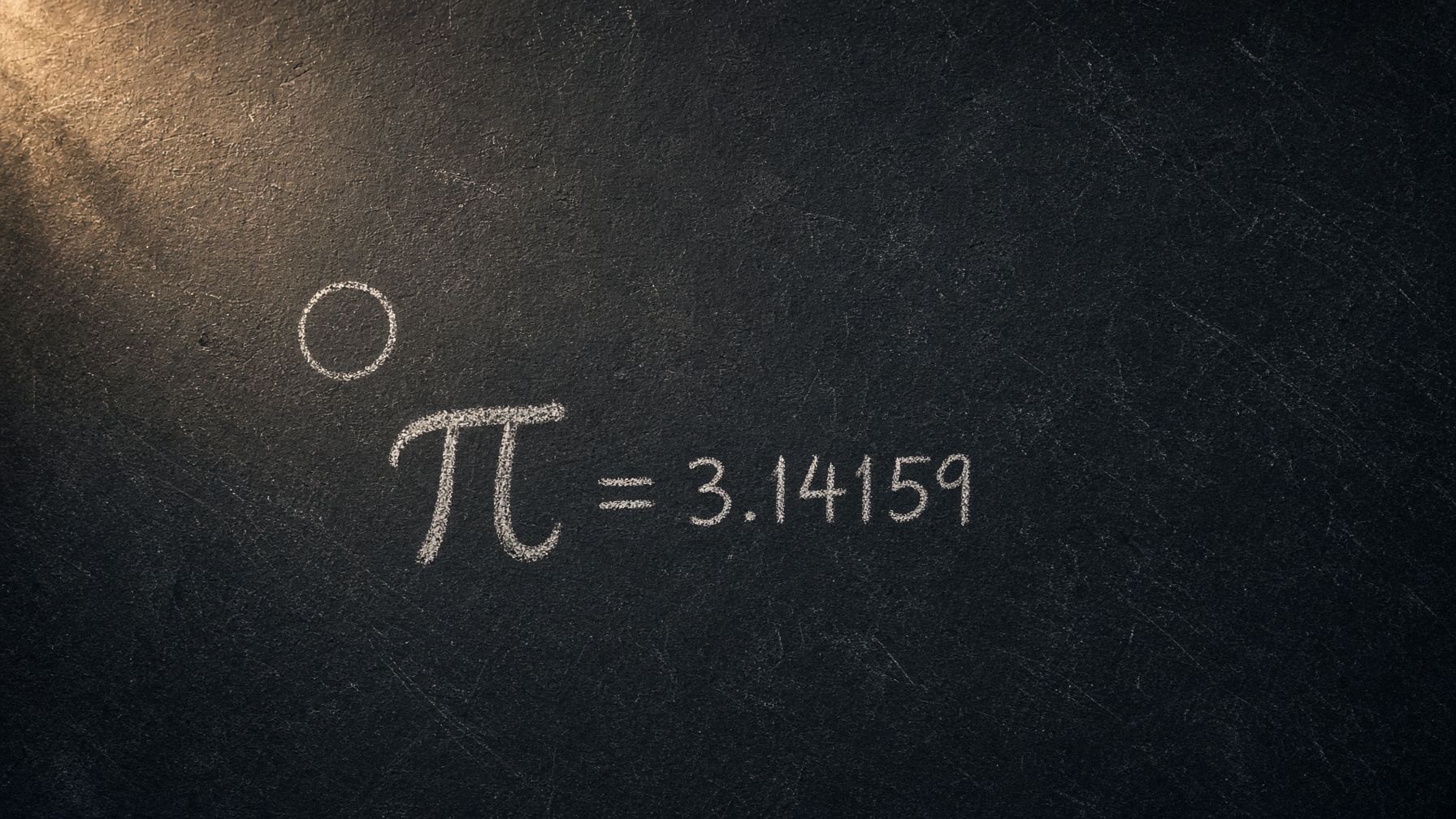
A circle drawn in chalk resembles a circle. The letter π does not. Yet the letter lets a person carry the ratio into an argument, a machine, a bridge. The slate in the photograph writes π = 3.14159. That decimal is a truncation. It is already a decision about how much of the ratio to keep. The mark is doing work the circle cannot do by itself: it can be copied, compared, and placed inside a larger expression.
eiπ + 1 = 0
Euler's identity is a compression. Five familiar marks hold a relationship among growth, rotation, the circle, and unity. You do not have to re-imagine a wheel every time you move a term. The same is true of H2O, which does not look like water, and of a variable, which holds a place open so a relation can be tried before the value arrives. Astronomers inherited glyphs for planets that are pure convention. Chemists inherited letters that let a reaction be rearranged on a page.
This is external symbolic storage. The page remembers a structure the working memory would drop. Merlin Donald described human culture as depending on that offloading. The claim here is modest. Notation does not think instead of a person. It lets a person think a relation that would otherwise be hard to hold. A calculator can carry the same marks further and still not know what a circle is for.
Leonhard Euler's identity is the standard relation eiπ + 1 = 0. The chemical formula and the planetary glyphs are ordinary examples of conventional notation, not claims about their first inventors.
Merlin Donald, Origins of the Modern Mind (Cambridge, MA: Harvard University Press, 1991), on external symbolic storage. The page uses that idea as a description of what notation affords, not as a complete theory of mind.
VIII
How does a machine know that you are you?
Two pieces. A shared edge. A person who remembers which fragment was given to which guest. The check is a fit, and the meaning of the fit was agreed in advance.
A password is two copies of a secret compared. A signature in cryptography is a mathematical relation between a key and a message. A QR code is geometry a camera can measure, plus a standard that turns modules into text. The recognizer may be a machine.
These are not Greek symbola in modern dress. A password does not descend from a juror's ticket by a straight historical line. What continues is the problem: how one thing stands in for, authenticates, or points toward another.
The differences matter. A tally can show that two holders correspond. It does not show that their agreement was wise. A cryptographic signature can show that a holder of a key approved a string. It does not show that the string is true. A QR code can open an address. It does not understand the page. Authentication is a check of correspondence. Signification is a practice of meaning. Machines are now very good at the first. The second is still a question about interpreters.
When a tool holds a name you cannot recall, or a map holds the turn, the symbol has left the hand and sits in a system. Human-Machine Collective asks what that phrase is asking, in the chapter where a tool holds something the person reaches for. That is distributed cognition. It is not yet a theory of consciousness.
Password comparison, authentication tokens, QR encoding, and public-key signatures are described here at the level of their function, not as a specification. A signature verifies a mathematical correspondence. It is not a Greek token and not a guarantee of truth.
Andy Clark and David Chalmers, "The Extended Mind," Analysis 58 (1998), is the nearby argument that some tools function as part of a cognitive loop. This page only needs the smaller point: symbols can be stored and checked outside a single skull.
IX
What kind of mind can live among symbols?

A symbol, even in the thinnest sense, asks an interpreter to treat something present as standing for something else. Sensation is not enough. The smoke has to be taken as smoke-of, the letter as a name, the fragment as the other fragment's pair. That "of" is the strange step.
It is not a human monopoly announced by slogan. Honeybees dance a direction and a distance. Karl von Frisch's account is mostly an iconic and indexical mapping, powerful and not a lexicon for discussing yesterday. Vervet monkeys give different alarm calls for different predators. Seyfarth and Cheney showed a referential pattern. The calls are limited. They are not a culture of rewriting. Terrence Deacon argued that symbolic reference, in which signs relate to signs and not only to things, is the harder threshold, and that human children cross it in a way other species rarely match. The honest question is degree and kind, not a badge that says only we.
Nor does every manipulation of symbols require understanding. A computer can apply rules to marks and return a well-formed string. John Searle's Chinese Room thought experiment says that syntax is not, by itself, semantics: a system can shuffle symbols it does not understand. You do not have to accept his conclusion about machines and minds to keep the distinction. Checking a token is not the same as knowing what the token is for. Consciousness asks what changes when a word splits a kind of knowing. Are We in a Simulation? keeps a harder line nearby: a model of a world is not yet a world.
Language, ritual, mathematics, maps, and law are ways of leaving meaning where another person can find it. The mind that can live there is one that can be wrong about what a sign is doing, and can ask again. That question is the rest of this page.
Karl von Frisch, The Dance Language and Orientation of Bees (Cambridge, MA: Harvard University Press, 1967). Robert M. Seyfarth, Dorothy L. Cheney, and Peter Marler, "Monkey Responses to Three Different Alarm Calls," Science 210 (1980). Terrence W. Deacon, The Symbolic Species (New York: W. W. Norton, 1997).
John R. Searle, "Minds, Brains, and Programs," Behavioral and Brain Sciences 3 (1980). The Chinese Room is a philosophical argument, not an experimental result. This world does not try to settle computational theories of mind. It only keeps manipulation and understanding apart.
X
When two pieces fit, what exactly have we learned?
The edges correspond. That is a fact about shape. It can establish that these two pieces belong to one another, if we already trust the test. It does not establish why they were broken, who kept them, or what the keeping meant. A password can match and still guard an empty room. A symbol can be shared and still be misunderstood. A metaphor can show a likeness and also smuggle a false one. Aristophanes' tally is a brilliant likeness for longing. It is not a description of every ancient token, and it is not a proof about love.
The editorial spine of this inquiry has been: fragment, correspondence, recognition, representation, relation, meaning. It is a path through this world, not a law of the universe. Correspondence and meaning are different relations. A dream can feel addressed to you. A number can return. A fit can be real. None of those, by itself, tells you what the pattern is for.
Forty-two can be a count. It can be the joke Douglas Adams typed. It can be a private marker, a research object, a literary wink, a sum someone produced by a rule. The numeral does not change when the field around it changes. CIPHER's page of 42s says the quiet part in its own voice: calculation is not interpretation, and a match is not a mechanism. The Book of 42 keeps a semiotics of the lattice, where number, attention, and recurrence are asked to stay distinct from a cause. Greek letters become numbers under another rule again in CIPHER's Greek isopsephy. Same hunger. Different office.
Noticing a pattern is not yet knowing what the pattern means. Wonder can survive that sentence. So can uncertainty.
If a symbol is one thing that lets us encounter another, how much of the world we experience is already made of things pointing beyond themselves?
When two pieces fit, what exactly have we learned?
Douglas Adams, The Hitchhiker's Guide to the Galaxy (1979), for 42 as the comic answer to the ultimate question. The number's other lives are not thereby explained. This chapter refuses to convert recurrence into causal proof.
Deep links used above were checked against the published pages: Twin Flames Union #platos-comedy, MythEngine /codex, Psyche /story, Consciousness /walk/the-split, Human-Machine Collective #meaning, Are We in a Simulation? /walk/worlds, The Book of 42 /map#semiotics, CIPHER /42 and /systems/greek-isopsephy.